Thursday, 29 August 2013

I Only Remember the First Times

A Dunedin retrospective.


Arriving on the bus into cloudy Dunedin in 2005 - a lot like future arrivals into Dunedin; no matter how nice the weather was elsewhere, it was always cloudy or raining on my return. We got picked up from the bus station by a friend. Driving around, Dunedin seemed like a real city!

Walking to university for the first time. A friend showed me the nice way through the botanical gardens. It was sunny and warm, but we still hadn't unpacked all of our boxes, so I was stuck wearing a long black skirt and boots. I remember talking to my supervisor and then the department administrator showing me around the place.

The first time I went to the university Taekwon-Do club (the club that I would later inherit), I thought I was going to die. They did a lot more intense exercise than my old club! Also, I was quite unfit!

A favoured running spot along the harbour, when I could run without feeling like death.

One of the first meals we had as a flat was sushi that I think I prepared.

The first time we heard our flatmate play his guitar, it was Nine Inch Nails. Yay for surprise common taste in music!

The first party I attended. Two people had a chocolate sauce drinking contest, with unfortunate consequences.

I remember freezing in the flat until the fireplace was installed, and then later chopping wood with the flatmates. I liked chopping wood. We also went from a temperature of less than 10 degrees C (good old Dunedin houses) in our living room to 25 degrees if we closed the door.

Dunedin from Flagstaff.

The first time I went to the university gym (probably 2007), I ran 2 km on the treadmill and thought I was going to die.

In 2008, we moved to a flat with a fantastic view of the city. I remember walking to university through town in the mornings. I still miss the beautiful sunny mornings at that place. That year, towards the end, I was able to run without feeling like I was going to die.

I taught my first Taekwon-Do class in 2009. I was nervous as hell.

PhD graduation at Otago with my family.

In 2011, we made a Bose-Einstein condensate in the lab for the first time. It was the culmination of a lot of work!

The last couple of years were really a blur of working, training, and almost no socialising. They passed very quickly! Almost too quickly.

Tunnel Beach: one of Dunedin's hidden gems.

I already miss the place.

Wednesday, 10 July 2013

What's in a name?

There is a problem with physics. I only became consciously aware of it last week when I was browsing through the arXiv in my research area, but it's something that has been quietly annoying me since I was a student.

There are no systematic naming conventions!

Let's look at some examples.

Particle Physics:
Particle physics naming conventions (or lack thereof) are famous for their ridiculousness. Particles have mostly been named mostly haphazardly as they've been discovered. The names are often cute. For instance, gluons hold quarks together (like glue, get it?). Why "quark"? The person who predicted them, Murray Gell-Mann, liked the way it sounded. Quarks have "flavours" which describe their type - up, down (okay so far), top, bottom (how is this different from up and down?), charm (??), and strange (???).

Quark kitteh has a flavor.

While particle names can provide hours of amusement, they do create a barrier to understanding what it is they actually do. I'm not sure that I would want them to change, though!
 
Quantum Gases:
What made me really annoyed about lack of naming conventions, though, was not particle physics, but my own field of ultracold atoms. A lot of inspiration for ultracold atoms research comes from condensed matter physics, so they can definitely take a lot of the blame for this. As I was browsing new papers on the arXiv, I suddenly realised that I didn't have a clue what half the papers were about from reading the title, because they were all about various effects that were named after the person or people who predicted/discovered them.

What are Fulde-Ferrel-Larkin-Ovchinnikov states? Damned if I know! And if you're going to use four hyphenated names to describe something, you might as well come up with an actually meaningful term for the phenomenon! This is rampant in my field. It's nearly impossible to describe what I'm studying without referring to phenomena named after people - Feshbach resonances, Efimov resonances, Rabi frequency, Bose-Einstein condensation (!), Ioffe-Pritchard magnetic trap. Every theoretical approximation has it's own name, usually with several hyphenated names. If you're not already familiar with the sub-field, you're gonna have a hard time.

It's jargon, pure and simple, and I think it makes it difficult for newcomers to the field or for general physics audiences. I can recall many occasions where I trawled through paper after paper to try to figure out exactly what something named after someone actually was.

Who is doing it right?
Lots of people!
  • Astronomy is doing pretty well. Celestial objects are usually denoted by coordinates in the sky. How logical! You have to be if you are dealing with as many objects as they are.
  • Chemistry! They have a logical naming scheme. It may be boring, but if you know the name of a compound, usually you know what it's made up of.
  • Biologists. This should be deeply embarrassing to physicists. Enzymes, proteins, etc. have names that specify their function.

Physics is certainly not alone in this, but in a discipline tasked with revealing the mysteries of the universe and describing complex behaviour using elegant formulae, surely we can do better?

Having said all this, perhaps the folks who invented copper nanotubes would have benefited from just naming them after themselves.

Wednesday, 16 January 2013

The r-index

Everyone within academia knows what the h-index is. For those who don't, it's a metric for how productive you are as an academic. The h-index itself is h number of papers with at least h citations. It's something that can easily be looked up via an academic's Google Scholar profile, Scopus, Web of Knowledge, and maybe others I don't know about. A higher h-index is supposed to be correlated to how productive you are as a scientist (number of papers published) and how meaningful your contribution to your field is (how often people cite your work). Universities love it. Human resources departments love it. Governments love it. Finally, it is possible to sum up the entirety of someone's value as a scientist with a simple integer value!

Or is it?

There are many problems that mask a person's true contribution to a field if one looks at the h-index alone. For instance, someone who has few but extremely highly cited (= important) papers will have a low h-index, even if they work they did was very far-reaching. The system is also easily gamed. For instance, self-citations are usually included in an h-index calculation, so you can cite yourself all the way to the bank. This guy probably takes the cake (he is a real person - I checked). If one defines another index, say w, where w is the number of papers where you have cited yourself at least w times, this could be particularly revealing of your citation habits. I have heard this dubbed the w-index (where w stands for "wanker", rather than Wu). There are also groups of people who regularly cite each other, thereby avoiding raising their w-index, but gaming the system nonetheless.

Ever since the h-index became a Thing, people have been getting a little crazy about it, and it's being used as a be all and end all metric (much like impact factor). Most of the alternatives I have seen proposed just seek to normalize the number of citations against some other quantity. I'm not convinced that any of these actually provide a measure of how much real impact, or reach, a person's research has.

My husband and I were talking about this over dinner, and he came up with a good idea: why not count the number of unique citations? I think this is quite promising. It completely eliminates double-ups (legitimately citing the same paper in multiple publications), self-citations, and gratuitous citations.

The r-index would be defined as follows: the number of unique citations that a given author has, where unique implies that no two citations share a common author, including the author being cited. The r-index could also be applied to individual publications.

If you have a high r-index, then it indicates that your research has reach within and possibly beyond your own sub-field. It likely punishes against papers with more authors, but perhaps this could be a handy tool against gratuitous authorship. I hope, though, that it wouldn't push deserving authors out of a publication, but I think this is highly unlikely.

What I really would like is to look at some real life examples of scientists at various stages of their careers and see if this is a reasonable measure, and what the r-index of an average academic is. I calculated it for myself. It was easy. I am only a fledgeling! When I tried calculating it for my supervisor, I immediately gave up. This cannot be done manually (unless you have a lot of time on your hands). Some data extraction from a citation database is required here! Stay tuned!


Saturday, 27 October 2012

Equality

Is equality the same thing as consistency?

In my country of residence, the powers that be are deciding if same sex marriage should be legal. At the moment, both homosexual and heterosexual couples can have civil unions, which legally amount to same thing as marriage, but with a different name. Proponents of the new bill are calling it "marriage equality", indicating that changing the law will allow same sex couples equal rights to those of heterosexual couples. Those opposing the bill do so typically on religious grounds. There is broad support for it, however, so it looks like it's going to pass.

It's very important that the law treats people in a fair and consistent manner. If heterosexual couples can get married, then homosexual couples should be able to do the same thing, in the name of consistency! Either that, or get rid of marriage altogether, since civil unions provide the same legal benefits (and pitfalls). This would, of course, be widely unpopular, but illustrates how gay couples probably feel about not being allowed to get married like their heterosexual friends.

Let's go beyond marriage equality. This sort of thing pops up all the time. Most democratic countries purport to have equal rights for all of their citizens. This is certainly not true in many cases. For example, children cannot vote, people don't all pay the same amount of taxes, two criminals who commit identical crimes often don't get the same sentences if they are from very different backgrounds, etc. There are very good reasons for some of these things, but others seem glaringly unfair, and two people will not necessarily agree on which it is!

Sometimes, you have to treat people unequally to level the playing field. Income tax rates are an excellent example of this. A certain amount of tax revenue is required to maintain various services (roads, the health care system, education, etc.). People in the lowest income bracket typically pay a smaller percentage of their income as tax compared to high earners. "But that's not fair!" Clearly things are not consistent here, but by allowing the lowest earners to pay less tax, the playing field is slightly evened out, making the situation more equal. It's counter-intuitive, but that's how it goes! Same goes for offering more scholarships to people from lower socio-economic backgrounds. The goal is a more equal society, but the path to getting there requires sometimes treating people unequally. It's basically a feedback loop! Also an endless source of arguments.

Monday, 10 September 2012

2312: A Book Review of Sorts

How would you live your life if you had 10 years to live? What about 200? What about a thousand?


The year is 2312, and humans have spread throughout the entire solar system during the Accelerando, a period of major technological advancement of humanity. Mars has been terraformed, terraforming of Venus is in progress, and various domed cities exist on several Jovian and Saturnian moons. The main character, Swan, is from a city on Mercury called Terminator, which is a domed city of around half a million people that sits on tracks, forever staying just out of reach of the Sun. In addition, many asteroids have been hollowed out, given a bit of spin, and inhabited. These are called terraria.

People in space ("spacers") enjoy extended lives thanks to longevity treatments. Some are living beyond 200 years in relatively youthful condition. Medical research is progressing, though, and maybe they can extend it to a thousand. The economic system functions as a series of cooperatives divided mostly into planets, with the economy (distribution of resources) being run almost entirely by computers. While it is certainly not a utopia, people's needs are generally provided for.

Hybrid quantum and classical computers are becoming more common. They call them qubes: 30 qubit quantum computers paired with very fast conventional computers. Of course, they are small - you can have one on a wrist pad or even embedded on your person*. And most of them come with their own AIs, which people tend to name. They basically run the show: economy, space flight, construction, you name it. You can give your qube a verbal instruction, such as "make our security system better", and it will go ahead and communicate with other qubes and get the job done in some way, though perhaps not the way you may have intended...

Earth then is like Earth now. It's a mess. There are 11 billion people, a high sea level thanks to global warming, widespread poverty, but also many places with very good conditions. Again, like now. Not everyone gets longevity treatments, and there is a lot of resentment of spacers. Many animals are extinct, and the kind of wrecked climate makes growing food hard. In fact, a lot of terraria are used to grow food for Earth, as well as acting as wildlife reserves, preserving animals extinct on Earth.

I won't go into much more detail. The book is a spiritual successor of Kim Stanley Robinson's Mars Trilogy, which I would recommend to anyone. 2312 fits somewhere between the Mars Trilogy and Galileo's Dream** chronologically, and the universes are similar, though I think not intended to be the same. Mars has a different history in 2312, for example, but Terminator existed in the Mars Trilogy.

What I love about Robinson's writing is that it's so plausible. His ideas aren't totally fantastic like a lot of science fiction. Everything is very well thought through and researched. There isn't silly stuff like faster than light travel and made up science (there are obviously postulations of future science and technology, but that is what makes it sci-fi). If you want to get somewhere in the solar system, it's going to take you a few weeks!

Back to my opening questions. I thought of them throughout reading the book. Our lives now are dreadfully short. A ten year time frame is not long; it's such that you would want to throw everything into it and experience as much of life as possible. I am 28. If things go well, I can expect 20 or 30 years of life without health problems bogging me down and keeping me from being active, maybe a few more if I'm lucky. That's not long at all! It's short enough that I have to make choices. This or that? Children or no? Am I in the right career? Probably, but there are so many other things I want to try that I have no time for!

Two hundred years, however, is a lot more reasonable. I wouldn't worry about choosing this or that. I could take my time with stuff. It would be fine to take a few years off to have kids, because it's a much smaller percentage of my life. There wouldn't be a constant rush to cram as much in as possible.

A thousand years changes everything. Assuming that everyone else also lives as long, it would be a very different world. I think people would value life much more than they do now. There is a lot more to lose.

"You could live for a thousand years ... But so, you... you should take care."


* And the present quantum computing research community lets out a collective LOL.
** There is a character that appears both in the Mars Trilogy and Galileo's Dream.

Sunday, 12 August 2012

So what do you do?

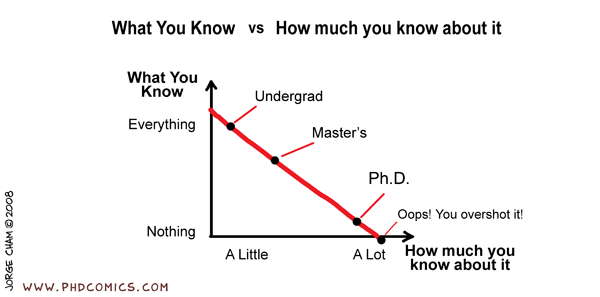
It's fair to say that most of my friends are not physicists or even scientists. When you do a PhD in something, usually what you are working on is so specialised that it's pretty difficult to explain it to someone who isn't in your field, or even subfield! For example, even though I have done a physics degree and now PhD, I only have superficial knowledge of topics like astrophysics, particle physics, string theory, etc. I even balk at the thought of having to do any serious theoretical calculations in my own field! However, I can (and have) built an experimental setup to cool things to nearly absolute zero. Give me some lasers and atoms, and maybe I can do something interesting with them! PhD Comics sums up the PHD conundrum nicely:


When you are in my situation, it's quite difficult to explain to people what it is you actually do. I can say I "play with lasers" and "study very cold gases", but sometimes I wonder if that makes people think of things like cats chasing laser pointers in a freezer. So, bit by bit, I'm going to talk about what my project was all about and explain the topics in layman terms. Stay tuned!

Tuesday, 31 July 2012

It Is Done

It still hasn't sunk in. More than two weeks ago, I finished writing my PhD thesis, and a bit more than a week after that (printing, soft binding), it was handed in. Finishing it feels something like this:


My life in the near future isn't changing enormously. I am still going to be working in the same lab as a research assistant and eventually a post-doc (when my thesis has been officially marked, hopefully not more than three months from now). Same work, much higher pay! By staying where I am, I can delay making life-changing decisions for a little while yet. It's not a total cop-out, because I'll hopefully be doing some nice experiments and get some more papers under my belt.

Maybe I will be a scientist when I grow up! I've already done grown-up scientist things like give a talk at my old university. And thinking about most industry jobs makes my insides shrivel up with boredom. Things are looking dodgy at best around the world, so a job offer is nothing to sneeze at.

While I sit around waiting for my files to back up to an external hard drive in preparation for a long-neglected OS upgrade, I'll reflect on my thesis writing process that may or may not be useful to others in the future. Arguably, this is the only part of my PhD that took more or less how long I thought it would. Anyway, here is some of what I did. Keep in mind that this is most relevant to science (physics?) theses, since most people spend all their time doing lab or computer work and only do the write-up at the end.

  • Do your introduction and background theory last. If you've already done some kind of big literature review, then maybe not. In my case, I didn't. By starting with experimental design and results, I knew what I needed to include in the background chapter and didn't include too much irrelevant information on topics that have been discussed to death in review papers and textbooks.
  • This is probably obvious, but write an outline of each chapter and sections, including what sort of figures you want to include.
  • Use LaTeX. Seriously. Even all you biology people. LaTeX + Bibtex (for the bibliography) will make your life much easier and you will avoid having some kind of Word behemoth to deal with. If you can use html tags, you can use LaTeX. Even if you don't, it's very straightforward, and there are many online resources, including PhD templates (your university might even have a template). It is also completely free.
  • As tempting as it may be, don't work all the time. Leave some time for exercise and entertainment every day, even if it's just a short run and a TV show episode. Also, eat healthy and sleep! You'll be more refreshed when you are actually working, and you'll avoid the dreaded Thesis Gut. I planned out what I wanted finished in a given time, and stuck roughly to it. If I finished a section in time, I purposely didn't work in the evening. Everything fell apart in the last 3 weeks and I was working all sorts of hours (and felt like crap), but I kept it up most of the time and it made thesis writing a relatively pleasant experience.
  • Mix up writing and making figures. I found this useful to prevent getting bored of doing just one thing all the time. Also, I spent most of my office time writing and most home time making figures, since it was a bit easier to concentrate like that. In fact, I would usually assign myself a very specific task to work on at home, such as "make a diagram of blah".
  • Back up your thesis to multiple locations. I backed up to dropbox twice or three times a day, and to an external hard drive every couple of days. Nothing ever happened, but better safe than sorry!
  • Try to have all your data when you start writing. I had to go back to the lab for a few things, and it was bothersome and interrupted my writing flow.
  • Have someone not in your group who is knowledgeable about your thesis topic read your thesis in addition to your supervisor/coworkers and local grammar nazi. Their feedback will be particularly useful, because people already familiar with your work will easily understand what's going on, whereas someone unfamiliar with the project may not find things obvious that you and your group members think are obvious.
  • Build up a good figure-making work flow. Sketching out figures on paper before drawing them on the computer is helpful. I got much faster with making figures as time went on. I used Inkscape for making diagrams and Matlab for data plotting. laprint is quite useful for making Matlab plots look nice in LaTeX, but can be bad for figures with subplots. For those (except 3D plots, due to poor performance), I used plot2svg and tweaked fonts and stuff in Inkscape.
That's all I can think of for now. Does anyone else have any thesis writing tips?

Tuesday, 12 June 2012

Prometheus

If you have yet to see Prometheus and don't want any spoilers, then maybe read this another time.

There were aspects of the movie that I greatly enjoyed. I liked the overall composition of it and the atmosphere. I enjoy the whole Alien franchise (except for the dreadful Alien vs. Predator movies), and it's nice how Prometheus ties some things together. I really liked the start of the movie, when David was on his own. Other people have drawn parallels to 2001: A Space Odyssey, and I can see the connection. I appreciated the little HAL-9000 tribute. The computer sounded so much like HAL, and it was cute when he called David by his name.

So what's the problem? The science and the characters! There was so much stupid, I don't know where to begin. I'll start with the trip itself. So they think the creators are on this moon and want to fly up and meet them. It's in some distant solar system that may or may not be in our galaxy (!), and everyone has to be in stasis for 2 years, the duration of the trip. When they get there, they seem surprised that the place isn't bustling with civilisation. Okay, forgetting the unrealistic space travel scenario there, isn't it standard practice to send some probes first? Like what we do now? It takes only two years to get to this place. It's not at all unreasonable to send a little probe, have it take some pictures and beam them back, drop some of those flying probe scanners in, or even make a return trip. That's sort of the sensible thing to do. Weyland can wait at home in stasis if he wants to make the trip himself.

This is a bad planet.

I guess I can give them the benefit of the doubt. They discovered the location of an alien planet and a big company is paying for the trip! I suppose I would also be pretty excited and impatient, but it would be stupid to get carried away and go in blind like that. The behaviour when they got there, however, is inexcusable.

These people are supposed to be scientists (and some "muscle"). As soon as they land, they go all Leeeerooooy Jeeenkins on the place, against the suggestion of the captain (one of the more sensible characters). They just run in and start touching stuff, opening doors, etc. Their way of exploring the place was something you would do in a computer game, not really a methodical, scientific approach. Certainly not something I would expect from an archeologist. In the end, the whole exploration turned into a big mess of their own doing. Fools!

The whole exogenesis idea as described in the movie is silly. I think they could have been slightly more realistic and said that humans and engineers have a common ancestor of sorts rather than having exactly the same DNA.

I've seen enough hentai to know where this is going...

The motivations of the engineers is unclear to me (and to everyone else, it seems). They "create" humans and then wish to destroy them. There are some things about the engineers that I'm trying to piece together. In the opening scene, one of the engineers drinks the black goo. Why? Suicide? Or deliberate poisoning of the surroundings and spreading of the bio-agent by throwing himself into the waterfall? I'm not sure.

I have another big question about the engineers. Did they really want to destroy humans again? Everything we know about their intentions comes from David, who clearly has his own agenda. He read the glyphs and learned the language. He is the one who talks to the revived engineer before he goes on his rampage. For all we know, he could have threatened him in some way, and carefully engineered the situation such that the others would die (except Shaw, who he seems to like). All we know about the engineers is what David tells us.

I still enjoyed the movie overall, I just wish it wasn't so stupid.

Wednesday, 6 June 2012

Transit of Venus

Unlike most of the rest of the country, we had a rather clear day today and were able to observe the transit of Venus. Furthermore, the transit occurred during the reasonable hours of 10:15 am to 4:30 pm. Very convenient!

The guys in the lab down the hall set up a little projector system with an ancient looking telescope, some polystyrene to block the light, and some paper taped to a board to project the image on, like so:


Venus was clearly visible in the projected image as a little dot slowly traveling across the sun:


We also had some neat filters that let you look at the sun directly through them. I tried to take a photo with my phone, but the image was saturated around the sun, so no good. Silly me, leaving my proper camera with adjustable exposure time at home!

Next time it will happen will be in 2117. None of us are likely to be alive then, unless life expectancy goes up drastically or we get robot bodies.

Saturday, 2 June 2012

Forging Ahead

I've been writing up my PhD thesis. That's right, I'm in that boat now. With any luck, I'll have it done at the end of this month. A lot of people hate the write-up phase of their PhD, but I've been really enjoying it. Part of it is that it's been a long time coming, and I'm happy to have reached that stage. The other is that I actually enjoy writing to some degree. I hated writing essays in high school, but I really like science writing. None of this arguing your point of view on something; if you have a point to make, show it with data!

So what next for me? For a few months at least, I'm sticking around in the lab trying to get some nice data and publish papers. I could potentially stick around for another two years, but I've been living in this town for seven years now and feel like a change! On the other hand, there are some reasons to stay a little longer too.

So what sort of jobs can a person with a physics PhD get anyway? Let's see...

  • Academia. Do a post-doc or two, try to find a position as a lecturer and run your own lab. Hard to get there, and the job itself is much more than 9-5 and the pay is low relative to industry. However, it is a very rewarding career, since you get to work on whatever you want, provided you get funding for it, and you get to stay in the nice bubble of academia. You are a scientist. I would consider this option.
  • The big bad finance industry. There is something called a "quantitative analyst". You need to have a physics, math or similar PhD to get the job, and good programming skills (Matlab counts). It's ideal for theorists who have spent their PhDs running simulations, but rumour is that you don't need to be a programming expert and that the sort of things they are doing are not really difficult for physicists, so maybe even an experimentalist like me could do it. Entry level salary: approximately $200,000 HOLY CRAP WHAT! But they take your soul, you see...
  • Working for a journal. You often need some experience as a researcher (post-doc or even more) to get to be something like an editor. Could be interesting.
  • A wide variety of industry jobs. I am told these exist and that they like people with physics PhDs. Apparently we are better at thinking outside the box than engineers, who are good at making things cheaper and more efficient and within specified parameters. You could be making washing machines or rockets. Who knows! I don't want to make washing machines, but I could potentially be interested in the right project, such as rockets.
  • An astronaut! Did you know that you need a PhD (physics being a desirable subject) to be one? Going into space is basically my ultimate dream. However, to get into the training program in the US, you need to be a citizen there. Oops. In fact, most national space programs require you to be a citizen of the respective country. I have citizenship of two countries, neither of which has a space program to speak of. One of them might get into the EU in a decade or so. Then I'm in, but otherwise, it looks bleak. Oh, you can also be an "astronaut" if you are very rich and can pay the Russians to get you up. Perhaps the finance industry is a way to get in on that route.
  • Civilian space industry. Companies like SpaceX. I would be keen on something like that. SpaceX takes their employees on zero G flights for company outings. That sounds great, and they hire all kinds of people and don't seem to be restricted by the same things as government organisations. I would strongly consider this. New Zealand has a private space company, but I haven't heard much about them.
  • A wide variety of jobs that don't require PhDs. There are many of those. Teaching, medical physics (working with radiation therapy equipment and such), patent offices, power companies, insurance (risk analysis), consulting, government ministries, and more. There are a lot of those kinds of things out there, and I don't really find them captivating.
  • Something completely different. Start a company? Become a reclusive genius? Evil mastermind? Costumed vigilante? Hitwoman or assassin (I do martial arts, I could be Beatrix from Kill Bill)? Spy? Freeloader? I could learn to use the ways of the force and be a Jedi, like my father.

I could totally do this.

 A lot to think about. Life changing decisions to be made soon!

Monday, 30 April 2012

The Blob in real life

I have been a terrible, terrible person and have not been updating my blog. I have been busy! I will try to fit more in...

Anyway, us physicists like to have fun occasionally, and one of our number decided it would be fun to make a non-Newtonian fluid at lunch last week.

What is a non-Newtonian fluid, anyway? Firstly, what is a Newtonian fluid? Newtonian fluids are kind of your every day fluids, such as water. No matter how fast you stir it or what forces you apply to it, the viscosity stays the same. Water doesn't suddenly feel like molasses if you try to mix it quickly, for example. Non-Newtonian fluids do not behave like this. They vary in viscosity depending on what forces are applied, and can have even weirder behaviours.

If you ever want to experiment with a non-Newtonian fluid, it's very easy. All you need is cornflour and water. You mix them together, and viola! You have a non-Newtonian fluid. I learned tonight that this particular mixture is called "Oobleck". There are many other common fluids that are non-Newtonian in different ways. Have a look at the Wikipedia page linked above!

Anyway, we made some and played with it.


Sunday, 5 February 2012

Sisters are doing it for themselves

There was an interesting article that came out in Science last week. The question of why some fields or careers, as well as high ranking positions in companies and government, are devoid of women is pertinent. In most first world countries, there is nothing stopping either gender from entering a particular career path (yes, there is still inequality, discrimination, glass ceilings and so on, and a few jobs with obvious physical limitations). For example, when I started my undergraduate degree, my first year physics course was populated by predominantly engineering students. I would say the class was 10% female. So it's not that women attempt to study engineering and are rejected, there are just not many who aspire to be engineers in the first place. Why?

The paper in Science is entitled Female Leadership Raises Aspirations and Educational Attainment for Girls: A Policy Experiment in India. Unfortunately, you need a subscription to read more than just the abstract, but I will give a summary.

In the early 90s, India experimented with having village council leadership positions restricted to women only for one or two consecutive terms in randomly selected villages. This is a really great thing for statisticians. There were three groups: the control (no female leadership), female leader for a single term, and female leader for 2 terms (allowing a measure of dosage). Now, all the kids who were born around that time are young adolescents, so the researchers interviewed them as well as parents. They interviewed several thousand people in all!

What they found was that in villages with female leaders, suddenly more girls had life aspirations beyond being housewives. They used a bunch of metrics, including whether they wanted to wait until the age of 18 to get married, whether they wanted a job that required tertiary education, etc. The effect also transferred to parents, who now had a wider range of career aspirations for their daughters. The other positive effect was that people had overall a better opinion of female leaders. Throughout all this, the aspirations of boys were never negatively impacted, so it was a win all around.


The authors concluded that the changes of aspirations of girls was the positive effect of having female role models. Rather than a role model being someone you want to emulate, I think of role models as someone you look at and think "I can do that too". Growing up, I never had an inkling of a doubt that as a female I couldn't do any kind of job. I had male and female teachers, my mom is a scientist, my grandma was an architect, I did karate as a kid and there were both boys and girls in the class. However, there are still countries and careers where women don't have the same life ambitions as men and are even viewed as being inferior for a job.

So here is my take home message: if you are a minority in your workplace, field, or hobby (be it gender, race, or anything else), keep at it! Even if things are difficult, remember that you are a positive role model for the next generation! Change happens slowly, but it does happen.

Wednesday, 25 January 2012

Smash!

Let's talk about collisions. Pretty much all physics experiments can be broken down into two categories: scattering (for example, particle accelerators) and interference (for example, Young's double slit experiment).

Example of a scattering experiment. I have been trying to convince the guys in the lab next door (who are actually working on an interference experiment) that they need to buff up and dress like this in the lab. Incidentally, the laser safety glasses that he is wearing are correct for the wavelength of light being emitted in the tube, if I compare them to a similar model from Thorlabs.
In certain regimes, the line between the two kinds of experiments gets kind of hazy. You see, there is this thing called wave-particle duality. Sometimes, matter acts like a particle (like little balls smashing into each other), and other times the same matter can act like a wave (like ripples in water overlapping with other ripples, making an interference pattern). This is true even for some large molecules. It is most definitely true for cold atoms, like the ones I am working on.

In our lab, we are doing scattering experiments. We take two clouds of very cold atoms (less than a microkelvin!) and smash them against each other. However, they are so cold that they no longer behave like particles, as your everyday gas would. They instead act like waves and interfere with each other! The way they behave when they collide is nothing like what would happen to a particle. It looks like this:

These are two clouds of atoms trapped in some laser beams. They are about 400 nK and there are half a million atoms in each cloud. We accelerate one cloud towards the other and then release them from their trap so they can expand after the collision. The expanding halo is made up of scattered atoms.


These atoms are moving at pedestrian speeds. If we increase the collision energy a little bit more, the pattern of scattered atoms will look a bit different and develops lobes in funny places. It's one of the things next on the agenda, so watch this space!

I will add a final note about particle accelerator experiments. To do interesting physics and make a name for yourself, it's all about going for extremes. For example, the LHC was made to do higher energy collisions than any other existing accelerator. The other, often forgotten, end of the spectrum is the super slow collision regime. That's where we're at! We're doing the slowest, lowest possible energy collisions! That's pretty extreme.

Sunday, 1 January 2012

2011 in Review

It has been 5 months since my last post. That's quite a long time! I have some good reasons for this. In fact, the one new year's resolution I have this year is to write more regularly!

At the end of every year (or start of the next one), I like to review the year and see how things have come along. This time, in particular, perhaps you can see why I haven't really had time for posting much. Also, this year I had two major (only) activities: physics and Taekwon-Do.


2011 In Review

Overall, the year can be summed up in one word: intense.

Let's break it down. 2011 was welcomed at a beach in Napier, after having driven for 12 hours around the East Cape of New Zealand. The next few days were spent traveling around the South Island with one of my close friends and my newly acquired husband. It was a nice trip, but made me realise that I don't really like road trip vacations. Sure, you see a lot, but it's tiring, and I would much rather go somewhere new and spend a few days getting to know the place instead of always being on the move.

Some time in 2010, I decided that 2011 would be the year that I go for my 2nd degree (dan) black belt in Taekwon-Do. Black belt gradings are pretty tough and require a lot of preparation and 100% commitment. I was mentally prepared to start training at the beginning of 2011, and a grading was scheduled for April. I began training 5 or 6 days a week and was generally enjoying myself with it. In March, the ITF Taekwon-Do World Championships were held in Wellington, and at the last minute I got flights to go watch. I'm glad I went, because I found it quite inspirational in regard to my own training.

During these few months, my new supervisor and I were trying to improve our experimental setup and figure out why we couldn't make Bose-Einstein condensates (BECs). We pulled things apart, put them back together, replaced electronics, optimised parameters, etc, but no luck. Even though we were making improvements, BEC still eluded us. It was good to go to training at the end of the day because I could physically vent all my mental frustration and not bring it home with me!

As I'm sure everyone knows, on February 22nd, an earthquake hit Christchurch. We felt it here in Dunedin, which is around 4.5 hours drive away. It was an aftershock of a quake in September, but that earthquake only caused some damage. This time, people died. Friends' homes were destroyed. The whole central city was closed down due to damage and unstable buildings. You hear about disasters around the world all the time and see the damage on TV. Somehow I always felt disconnected from them. This time, it was in my own back yard and my own friends that were affected. It was heartwarming to see all the volunteer initiatives to help Christchurch residents, and it definitely restored some of my faith in humanity! Unfortunately, they are still being shaken by earthquakes and jerked around by politics and insurance companies. I really hope they get a break soon!

Around the end of March, our grading got postponed until July due to lack of numbers. I felt a little bummed, but was glad to have more time to train. I should add at this stage that not only do I practice Taekwon-Do, but I am the instructor of my university Taekwon-Do club, so my own personal training (usually at other clubs) is in addition to the two classes a week that I teach during the semester (though I have some very nice assistants!). By coincidence, around this time, a person I knew who is higher ranked than me who had quit Taekwon-Do a year before suddenly had plenty of time that needed occupying due to a change of personal circumstances. So I asked him to train me, initially just for fitness, and slowly (but unintentionally!) got him back into Taekwon-Do and he eventually joined my club and we became friends.

In May, we had our regional tournament. In the past, I was never a strong competitor, but the training payed off and I got a couple of medals! Our club also got 2nd place overall. My TKD returnee made a very good coach and helped all of us improve our sparring. Unfortunately, around this time, the July grading was canceled due to lack of numbers, so I had to wait until December to grade in the North Island (where there are many more people doing TKD, so the gradings are a lot more regular). A setback, but in the meantime, we would concentrate on the national tournament in August.

Back to the lab: we were dredging the bottom of the barrel. I pored over PhD theses and all kinds of stuff looking for problems other people had that prevented them from getting BEC. The game is to cool a cloud of atoms to almost absolute zero and still have enough atoms in your sample to do interesting experiments. We could get our atoms to less than a microkelvin, but then something would heat them up again, preventing us from reaching the density and temperature needed to form a condensate. In July, on an unusually cold weekend, we finally cracked it. This was an immense relief. The end of my PhD was finally in sight!

From that point on, things moved quickly. We moved into testing out our ultracold atom collider (I will do a post on this later). Just imagine a montage of happy physicists running experiments, collecting data, plotting graphs, writing papers, etc. Fun times! And for me, the evenings were filled with punching, kicking, breaking boards, running, sparring, etc. Personal social life: nil.

For once, our club had a decent contingent going to nationals. We trained together on Sunday mornings, doing 1.5 hours of some sort of sadistic running exercise devised by our coach (the returnee), followed by 1.5 hours of sparring training. The tournament went well. We didn't do spectacularly in terms of placings, but everyone did well. I was certainly very proud of everyone and myself!

Things in the lab plodded along for the rest of the year. We had a setback or two, but nothing dramatic. We submitted a paper on the collider recently. My first paper!

By November, I was starting to feel tired. Training 6 days a week and spending the rest of the time in the lab was getting exhausting! I felt ready, and just wanted to get the grading over with! I should note, at this point, that the first time I went for my black belt, I didn't pass. There were a number of reasons for it, but mainly I was just not that well prepared. 6 months later, I re-tested and I did pass, but the whole thing left me feeling like I just wasn't very good at Taekwon-Do. I became an instructor straight after getting my black belt, not because this was a personal aspiration, but out of necessity, because the previous instructor had finished his studies at university and was moving overseas, and I was the next most qualified person. At the time, I felt like I just barely made it to black belt and that I wasn't cut out for much more.

This year taught me that I am cut out for more. I passed my 2nd dan grading, and I got an A. I certainly didn't do it on my own. Everyone has people helping them for gradings, and I am very thankful for the people who helped me (other more senior instructors and also my personal coach). I now have more aspirations for competing and look forward to this year's tournaments and training some of my students for their black belt grading.

In the lab, perseverance has paid off. Every year, I wish for success in the lab. In 2011, it actually happened and that makes me very happy! The next few months will see the final push to finishing my PhD, which I look forward to very much!

2011 was an intense year. It was a year of sadness and stress for many of my friends. It was also a year of happy events for friends as well (five couples I am friends with got married, one of them expecting their first child any day now). It was a year of frustration in some areas, and ultimately a year of overcoming obstacles and learning that I can be better at whatever I want to be as long as I put in the effort.

Sunday, 31 July 2011

This was a triumph

I have been eerily quiet lately (on here anyway), and with good reason. After a very long time of toiling away in the lab, we finally managed to make something that has been eluding us for some time: a Bose-Einstein condensate!


A Bose-Einstein condensate (BEC) is a state of matter that occurs at extremely low temperatures. Other notable states of matter that you may be familiar with in your day to day life are gases, liquids, and solids. Usually the thing that determines what state something is in is temperature, with a fairly strict cutoff between states. The boiling point of water (100 degrees) is a good example. Pressure affects where those cutoffs are, so if you are high up on a mountain, the pressure is lower, and your water will boil at less than 100 degrees.

Not to any kind of scale and blatant disregard for using consistent units.

BECs are cold. Real cold. Ultracold (official term), in fact! They are so damn cold, you can't get anything colder. There is a hard limit in temperature called absolute zero. Nothing can be at absolute zero. It's impossible! However, you can get very very close, and at a billionth of a degree above absolute zero, BEC is a good example. Atoms in a BEC are all as cold as you can get. They are cold because they have very little energy, and they all have the same energy. They act in unison and behave more like waves than particles.

BECs don't occur naturally in the universe (that we know of) because space is much warmer, thanks to the cosmic microwave background. Instead, we have to play all kinds of tricks to get our atoms cold. An experimental setup like this is required for it:

This is around half of the setup.


I suppose you can see why it might take a long time...

Sunday, 3 July 2011

Laser Cooling

One of the key techniques used in ultracold atoms experiments is laser cooling. Normally people think of lasers being used to heat things up since they are intense beams of light, so how would you cool something with one? I will answer this question, to spare you tossing and turning all night, unable to sleep because of the inner turmoil of not knowing how lasers can possibly used for cooling.

I'll start with atoms. Atoms in a gas at room temperature move very fast and therefore have a lot of energy, since energy is proportional to velocity squared. Light is made up of photons, which carry momentum that is proportional to the frequency (or colour) of the light. When an atom and a photon collide, they exchange energy. If you get the laser frequency right, then when the photon and atom bounce off each other after the collision, the photon will come out more energetic, and the atom less energetic. The atom is now slower, and therefore has less energy, and is therefore cooler (high temperature = high energy).

There are a few applets at Physics 2000 that let you play around with a few parameters and help you see how laser light can be used to slow atoms down. Check out the rest of the site too! I found it great for learning about Bose-Einstein condensation for the first time, a long time ago...

So far, this is a very simple picture. In real life, things are more complicated. The atoms and photons don't literally bounce off each other. Instead, the atom absorbs the photon and then spits it out again! One might naively think that atoms could be fully slowed to a stop by doing this, but alas, it is not so. There are a couple of limits related to the fact that the atom is always absorbing and emitting photons. However, when physicists hear about limits, they consider them to be a challenge. If that atom won't get any colder, can we trick it into getting colder? The answer is yes.

Have you heard of the legend of Sisyphus? He was a king in ancient Greece who angered the gods, and as punishment, he had to push a huge boulder up a hill, but when he got to the top, the boulder rolled back down and he had to start again. For eternity.


It turns out that by playing some tricks with polarisation, one can replicate this experience for an atom. The atom will always see an uphill potential and will climb the hill. When it gets to the top, it gets transfered into another state and suddenly finds itself at the bottom of a new hill. It looks something like this:

Nicked from here.

This is actually called Sisyphus cooling. You can't stop an atom completely like this (or really at all), but you can make it damn cold! I should note that this is exactly how I feel on Sunday mornings when I voluntarily run up and down a hill for "fun". Try it! You'll love it!

Saturday, 2 July 2011

Crackpots

I don't know how prevalent they are in other fields, but physics seems to attract more than its fair share of crackpots. Either that, or I only notice because I'm doing physics. They are mostly harmless, but occasionally they write books and contaminate the minds of the unsuspecting public. (By the way, if you are a physicist or have somewhat of a physics background, check out the free chapter of that book. It's like a sort of physics slapstick comedy.)

I've had various experiences with crackpots over the years. On more than one occasion, ragged, disheveled looking people have wandered into the physics department desperate to talk to someone about their amazing theory that will surely solve some longstanding physics problem or solve the world's energy needs. In all cases, they have little to no physics background and a poor grasp of maths, and they are also very easy to spot from a distance.

I actually (hopefully) managed to discourage one such person. This guy said he had a background in surveying and complained about how current technology for imaging underground was not very good. It's based on blasting sound waves into the ground and then observing their reflections (they do something like this in Jurassic Park). He thought that a far superior method would be to use cosmic rays and that he just needed some help to get his idea off the ground.

Another sort of crackpot exists as well. This is your average person on the street who is not satisfied with (and nearly 100% of the time doesn't understand) a particular theory and comes up with their own. Of course, what they have is just an idea, not a theory as such. I really wouldn't care about this very much at all, but for some reason these people gravitate towards me in social situations. Here is an example of one such situation that took place at a party. I was sitting on the couch minding my own business, when a guy sat down next to me and started making conversation:

Guy: Hi, I'm Bob. How do you know [Party Host]?
Me: Hi. We are students in the same department.
Guy: Oh! So you do physics too!
Me: Yeah.
Guy: Okay, so I have this theory about the universe... I think it's way better than [Standard Accepted Explanation]. Gee, I really like physics, but I never understood maths.

I actually can't remember what his theory was, though I can assure you that it was 100% crackpot. I was in panic mode at that stage, trying to figure out how to politely extract myself from the conversation. Luckily, he got distracted by someone else and went away. Phew. Unfortunately, the next guy who sat next to me proceeded to do exactly the same thing upon hearing that I do physics. I made some excuse, got up and went home. Enough was enough.

I'm told that a similar phenomenon exists in psychology, where people have a driving need to tell psychologists their "theories" about human behaviour. I'm curious about other fields, even non-science fields. Does anyone else have any experiences or funny stories about crackpots?

Monday, 23 May 2011

Lab Tours

Every so often, we give labs tours to high school students. Usually they have an interest in science or are part of a special program. I think walking into a lab like mine can be a little overwhelming for a lot of them. Explaining the physics of what I do is also a little tricky because it's not a topic at all covered in high school, but I do my best to draw analogies with ideas they are familiar with. Some students definitely get more than others. If they are totally quiet, I get the feeling that they didn't understand anything. I consider it to be a good sign if they ask questions!

A few weeks ago, a group of such students came to the lab for a tour. They were part of a group of minority students gifted in science - the kind of kids who will hopefully study science at university. I talked to them a little bit about what it's like to do a PhD (something they didn't know much about), and how it's a lot more practical than studying, doing assignments and taking exams. I also mentioned teamwork. Experimental physics is usually not an isolated venture; it's very common to work in groups of 3 or 4 people on the same project. In my explanation, I happened to say that me and a few other people built up the experimental setup, which involved a wide range of skills.

One girl cut me off.

Girl: You mean you built this yourself??!!
Me: Well, me and some other people. I didn't do it all myself by any means.
Girl: Wow!
Me: ...
Girl: Can you make a TV??
Me: That's more of an electronics engineering thing. Maybe I could assemble a TV, but I wouldn't know how to design all the electronics to make it work.
Girl: Can you make a boom box???


Impress teenagers with your physics skillz. Make a boom box.

Saturday, 21 May 2011

Photography Contest!

The local museum runs a wildlife photography contest every year. There are three categories: plant, animal, and human impact on the environment. Last year was the first time I entered, and I won a highly commended prize for this photo:


Getting that photo was mainly luck. We were walking on the beach and happened to come across the car. It was late afternoon and the lighting was just right.

The contest rules stipulate that the photo must be taken no earlier than January 2010, and in that time, I have not come up with anything nearly as cool as the car. Out of everything, this is what I came up with and submitted last week:


Click on the captions to get to the high resolution version.

I'll find out how it went in the next couple of weeks!

Friday, 20 May 2011

References

Information spreads quickly on the internet, particularly through social networks like facebook and twitter. Someone learns an interesting factoid, finds a meaningful quote, sees an inflammatory news item, funny video, etc. and immediately shares it with their friends. Very often these tidbits are copied and pasted from friends' status updates or blogs without much thought. I've certainly been guilty of this myself.

It's only natural that misinformation travels through these channels, and it's actually nice to see that only a small portion of shared items (at least from my social group) are blatant conspiracy garbage.

So how can you tell if what you're reading is cow turd, anyway? Read the references! Most of these articles/blog posts/websites have links to the evidence they say backs up their claims. The recent DCA hysteria, documented and debunked nicely in Arstechnica, is a great example of this. It took me about 5 minutes to click on a couple of links from the original page to figure out that this was written by someone who 1) does not understand the process medical treatments need to go through from initial lab tests to treating people, 2) has not done high school level cell biology, and 3) does not have good reading comprehension.

The lesson here is that when you come across something that sounds like a conspiracy or is too good to be true, follow a few links from the source. It doesn't take long to figure out if it's legitimate or crazy talk. Read the references, people!